Former mills turned studios, triple-deckers on the hill, and the river running through it.
By Junia Janvier, REALTOR® · Corcoran Chart House Realty · Updated October 2026
The Valley is where Providence’s industrial past and its arts scene meet along the Woonasquatucket River. This guide covers the neighborhood’s history, its blocks and housing, what homes cost to buy and carry, how residents get around, and what buyers should check in a district that is still evolving.
The Valley sits in northwestern Providence, bounded by Chalkstone Avenue to the north, Raymond Street to the east, Harris and Atwells Avenues to the south, and Academy Avenue to the west. Valley Street runs through the middle, with homes to the north and old factories and mills to the south along the Woonasquatucket River.
The river’s current powered the mills of Rhode Island’s industrial era. Along this stretch, the Rhode Island Locomotive Works put up a building in 1865 that later belonged to the American Locomotive Company, the Banigan rubber works opened in 1896 and became a regional U.S. Rubber plant from 1910 to 1975, and the Providence Steel and Iron Company grew from a structural steel shop built in 1902. Mills dyed, bleached, and finished cloth for the textile factories upstream.
When industry left, the river was polluted and many buildings sat empty. The Woonasquatucket River Watershed Council formed in the early 1990s to clean it up, and federal brownfield funding helped clear contaminated sites. Artists moved into vacant mills in the 1990s, and in 2002 the former Providence Steel and Iron site reopened as the Steel Yard, an industrial arts center listed on the National Register in 2005.
Today the Valley Arts District runs along the river with studios, galleries, performance spaces, and offices in converted mills. The annual FringePVD festival uses venues here, and the Latino performing arts company Teatro ECAS moved into the district in April 2023.
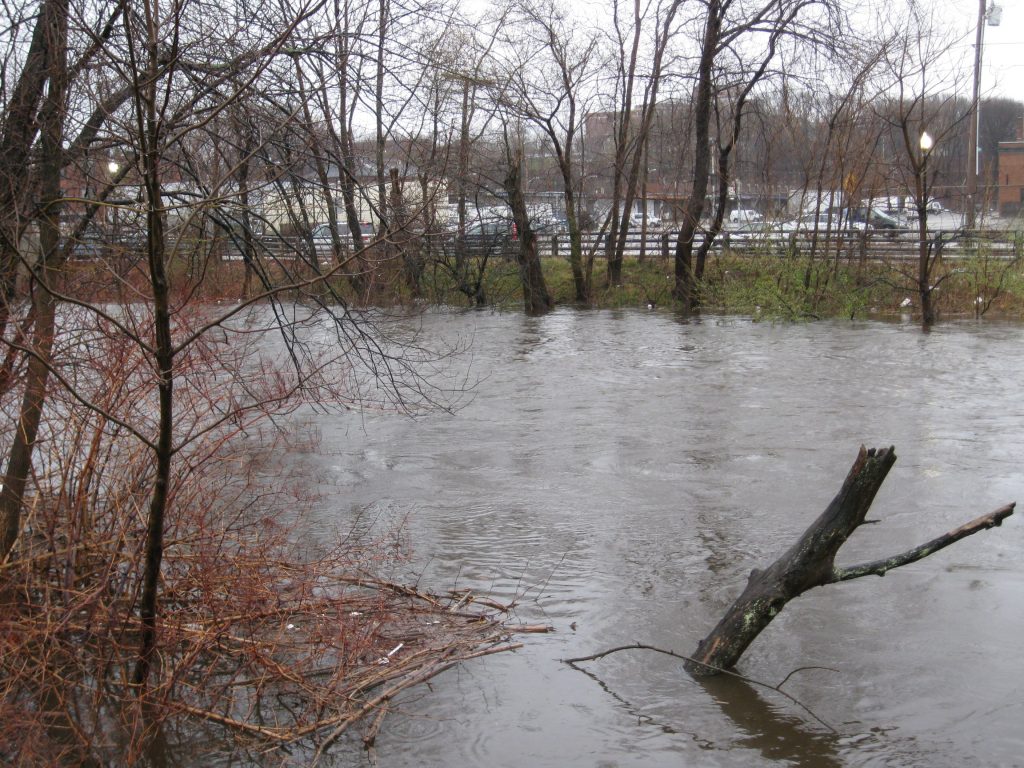
The Woonasquatucket River
Getting oriented
Streets, blocks, and sub-areas
North of Valley Street
Residential blocks rising toward Chalkstone Avenue, lined with double- and triple-deckers. This is where most of the neighborhood’s homes are.
The Valley Street corridor
The main street, with mill complexes on one side and houses on the other, and a growing mix of workplaces, food, and drink.
Along the river
The Valley Arts District, the Steel Yard, and converted mills near Kinsley and Sims Avenues, with lofts and studios close to the greenway.
Toward Atwells Avenue
The southern edge near Eagle Square and the Harris Avenue mills, a short walk from Federal Hill and Olneyville.
Housing
Homes and architecture
The Valley’s housing is split between two worlds. North of Valley Street are wood-frame double- and triple-deckers built for mill workers; south of it are brick mill buildings, many now converted to lofts and apartments. The Eagle Square redevelopment preserved four mill buildings and set aside artist studio space, and hundreds of millions of dollars have since gone into nearby mill conversions.
Two- and three-families: the most common homes for sale, and the classic owner-occupant rental property
Mill lofts: condos and apartments with high ceilings, large windows, and exposed brick in converted factories
Single-families: fewer of them, mostly on the residential streets north of Valley Street
Rental demand: strong, with downtown, Providence College, Rhode Island College, and the hospitals within a short drive
Market deep dive
The market and what homes cost to carry
Only a handful of homes sell in the Valley each month, so the median moves with the mix of sales. In September 2026 the median sale price was around $625,000, and homes typically sold in about 23 days. Compare recent sales of the same home type nearby before setting an offer.
Property taxes, worked out
Providence taxes owner-occupied homes, and especially owner-occupied multifamilies, at a much lower rate than investment properties.
Home type and value
Rate per $1,000
Yearly tax
Monthly
Owner-occupied 2 to 5 family, $625,000
$7.55
$4,719
~$393
Same 2 to 5 family, not owner-occupied
$14.00
$8,750
~$729
Owner-occupied loft condo, $350,000
$8.40
$2,940
~$245
Assessed values often differ from sale prices, and exemptions can change the bill. Rates: City of Providence FY2027 Municipal Levy Ordinance.
Living in one unit of a triple-decker saves thousands a year in tax compared with owning it as an investment, and rent from the other units can offset much of the mortgage.
Commute & transit
Getting around
On foot: the arts district, Federal Hill, and Olneyville Square are a short walk from most blocks
By bike: the Woonasquatucket River Greenway runs along the river to Providence Place and the downtown Riverwalk
By bus: RIPTA routes serve the area on the main avenues toward Kennedy Plaza
By train: Providence Station, with Amtrak and MBTA commuter rail to Boston, is about 5 to 10 minutes away by car
By car: Route 10, Route 6, and I-95 are minutes away
By air: Rhode Island T. F. Green International Airport is about 15 to 20 minutes south by car
Outdoors
Parks and the river
Woonasquatucket River Greenway: about 5 miles of on- and off-road path from Johnston to downtown, running right past the neighborhood
Donigian Park: on Valley Street at the edge of Olneyville, where an off-road stretch of the greenway begins
The river: paddle tours run on the Woonasquatucket in season, and volunteers help maintain its parks
The Steel Yard: its grounds host workshops, public art projects, and community events
Riverside and Merino Parks: a short ride west on the greenway for fields, playgrounds, and river views
Lifestyle
Daily life in the Valley
The Valley is a place where people make things. Studios, workshops, and small manufacturers share the mill corridor with offices, breweries, and food businesses, and a year-round indoor farmers market runs on Saturdays in the district. The Steel Yard offers public classes in metals, ceramics, jewelry, and foundry work.
Evenings bring gallery openings, theater, and rooftop events, and the FringePVD festival fills local venues with performances each year. Federal Hill’s restaurants and downtown are close by.
For schools, Providence Public Schools uses a citywide enrollment process; families can review options and school data through the Providence Public School District and the Rhode Island Department of Education.
Honest take
Pros and tradeoffs
What people love
Creative energy and a deep arts community
Loft living in historic mills
Steady rental demand for multifamilies
Greenway and downtown within minutes
What to weigh
Light industry still operates next to some homes
Few sales make pricing harder to read
Blocks near the river need a flood review
Ongoing development is changing the area quickly
Buyer checklist
What to check before you buy in the Valley
Flood zone: look up any property near the Woonasquatucket on FEMA’s flood maps and get an insurance quote early
Neighboring uses: visit on a weekday to see whether nearby businesses bring noise, trucks, or fumes
Older homes: budget for inspections that look closely at lead paint, wiring, and heating
Loft condos: review the association budget, reserves, and any special assessments in converted mills
Multifamily numbers: review leases, rents, and unit condition before you count on rental income
Nearby development: ask about planned projects on nearby mill sites, since the district is still changing
FAQ
Questions buyers ask about Valley
What kinds of homes are in the Valley?
Mostly double- and triple-deckers north of Valley Street, plus lofts and apartments in converted mills along the river.
Is the Valley good for house hacking?
It can be. Multifamilies are the most common homes, rental demand is strong, and owner-occupants pay $7.55 per $1,000 instead of $14.00 on a 2 to 5 family.
Is the Valley in a flood zone?
Some properties near the Woonasquatucket River are. Check each address on FEMA’s flood maps and get an insurance quote before making an offer.
What does a home in the Valley cost?
In September 2026 the median sale price was around $625,000, though only a handful of homes sell each month, so prices can swing.
Work with Junia
Thinking about Valley?
Junia Janvier is a REALTOR® with Corcoran Chart House Realty who helps buyers and sellers across Rhode Island, in English and Haitian Creole. Bring your budget, your timeline, and your questions, and she will help you see where Valley fits.
Sources: Redfin neighborhood data, September 2026 (small monthly samples, so expect swings); City of Providence FY2027 Municipal Levy Ordinance; The Steel Yard; Rhode Tour; Woonasquatucket River Watershed Council; Rhode Island Department of Transportation (Woonasquatucket River Greenway); Wikipedia article on the Valley. Figures change often and are provided for general information only; contact Junia for current numbers. Photos: Mill building by John Phelan (CC BY-SA 3.0); Woonasquatucket River by Jef Nickerson (CC BY-SA 2.0), via Wikimedia Commons.
Junia Janvier, REALTOR® | Corcoran Chart House Realty | 47 Maple Avenue, Barrington, RI 02806 | (401) 246-4198 | RI License RES.0201111. Corcoran and the Corcoran logos are trademarks of Corcoran Group LLC. The Corcoran® System is comprised of company owned offices which are owned by a subsidiary of Anywhere Real Estate Inc. and franchised offices which are independently owned and operated. The Corcoran System fully supports the principles of the Fair Housing Act and the Equal Opportunity Act.
Equal Housing Opportunity
Top
Stay in the Loop
Get insights, resources & ideas delivered straight to your inbox. No spam, ever.

 Equal Housing Opportunity