Historic streets in the shadow of the State House dome, a short walk from downtown.
By Junia Janvier, REALTOR® · Corcoran Chart House Realty · Updated October 2026
Smith Hill rises just north of downtown, with the Rhode Island State House at its southern edge and blocks of 19th century homes behind it. This guide covers the neighborhood’s history, its historic district, what homes cost to buy and carry, how residents get around, and what buyers should check before making an offer.
Smith Hill sits just north of downtown, traditionally bounded by the Woonasquatucket River to the south, I-95 to the east, the West River area, and the Chad Brown housing complex to the north. The neighborhood is named for John Smith, an early settler who built a grist mill here in 1636. Smith Street, the neighborhood’s main road, carries his name too.
For two centuries the hill was mostly farmland and a rural retreat from the town below. Industrialization changed that. The Woonasquatucket and Moshassuck Rivers powered nearby mills, and from the 1800s into the early 1900s immigrants from Ireland, Eastern Europe, and the Balkans settled here to work in them. An Armenian community also took root in the early 1900s.
The Rhode Island State House, built from 1891 to 1901 and designed by McKim, Mead & White, sits on the neighborhood’s border with downtown. Its white Georgia marble dome is often described as the fourth largest self-supported marble dome in the world, topped by the Independent Man statue. The building is so closely tied to the neighborhood that “Smith Hill” is shorthand for the General Assembly.
After World War II, many mills and factories closed. Since the 1970s, community groups have worked to reinvest in the neighborhood, and today the Smith Hill Partners Initiative brings residents, institutions, and businesses together for regular community meetings.
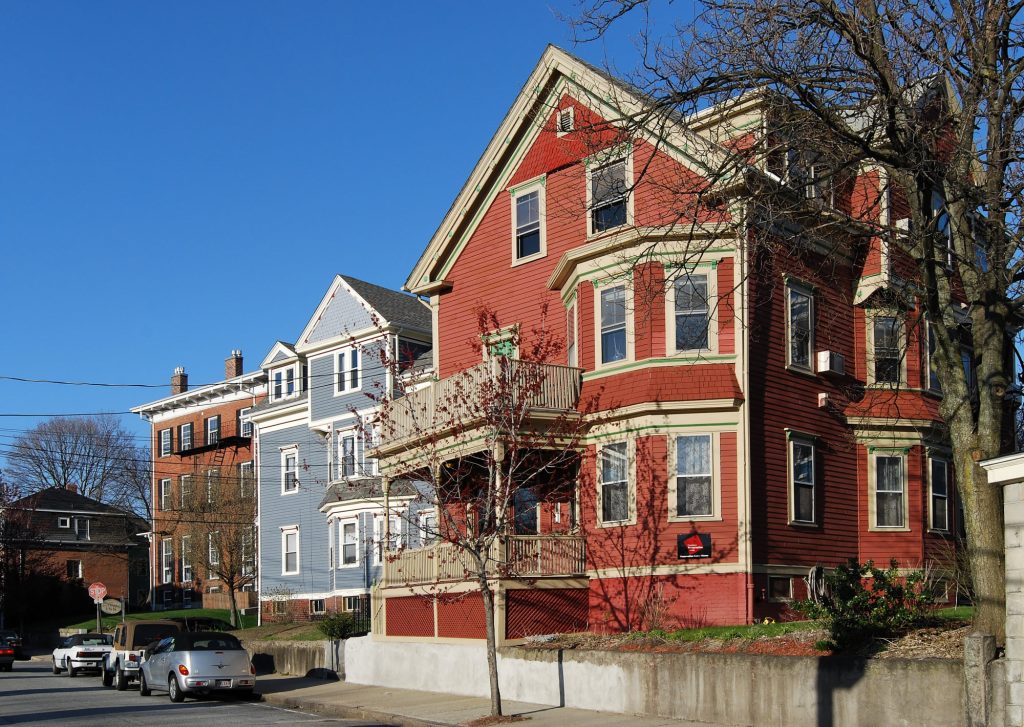
Holden Street, part of the Smith Hill Historic District
Getting oriented
Streets, blocks, and sub-areas
Smith Street corridor
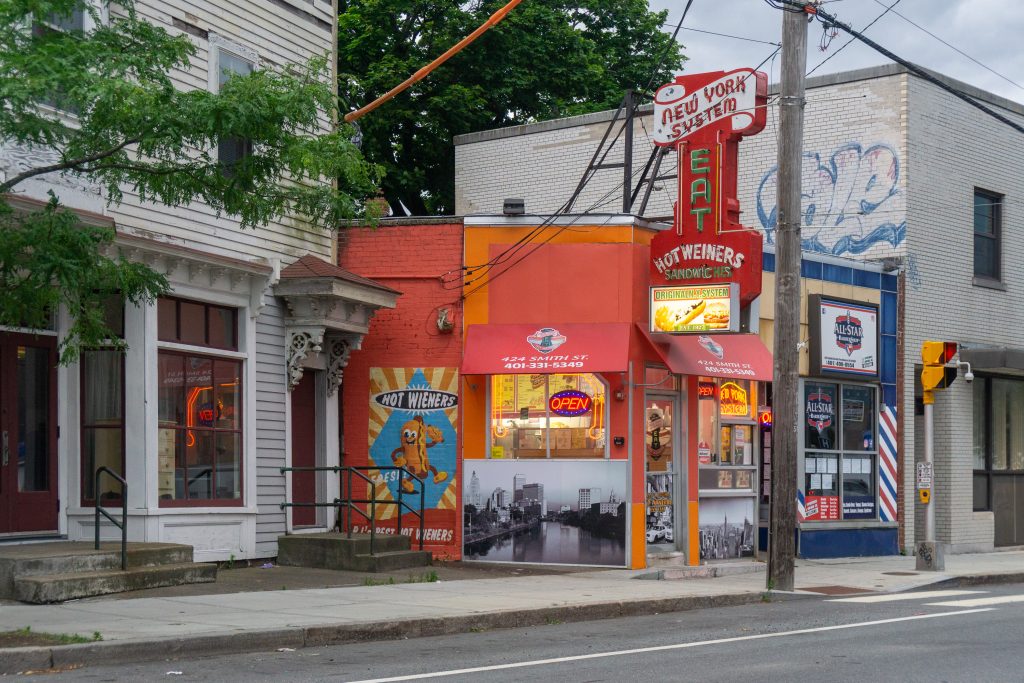
The main street, with shops, services, a post office, and long-running local eateries. Busier, with bus service and quick access downtown.
The historic district
Holden, Jewett, and Brownell Streets and part of Smith Street just west of the State House, with Italianate and Greek Revival homes close to the sidewalk.
Near the State House
Blocks closest to the state government campus, where weekday parking is in high demand and downtown is a short walk away.
Toward Chalkstone Avenue
The northern and western blocks near Davis Park and Roger Williams Medical Center, with more residential side streets.
Housing
Homes and architecture
Smith Hill is densely built, and much of it is multifamily. In the historic district, most homes were built between 1870 and 1930, typically 2.5 or 3.5 stories on lots of about 3,000 to 5,000 square feet. Beyond the district you will find more two- and three-family houses, some single-family homes, and a few condos.
Two- and three-families: the most common home type and a strong fit for owner-occupants who want rental income
Historic homes: Italianate and Greek Revival houses in the National Register district
Single-families and condos: fewer in number, often the most accessible way into the neighborhood
Rental demand: supported by state offices, hospitals, Providence College, and downtown employers
Smith Street
Market deep dive
The market and what homes cost to carry
In the three months ending August 2026, the median sale price on Smith Hill was around $574,000, and homes typically sold in about 46 days. Samples are small, so expect swings. Smith Hill’s central address still comes in below many downtown-adjacent neighborhoods, especially for multifamily buyers.
Property taxes, worked out
Providence taxes owner-occupied homes at a lower rate than investment properties, and the gap is largest on 2 to 5 family homes.
Home type and value
Rate per $1,000
Yearly tax
Monthly
Owner-occupied single-family, $450,000
$8.40
$3,780
~$315
Owner-occupied 2 to 5 family, $575,000
$7.55
$4,341
~$362
Same 2 to 5 family, not owner-occupied
$14.00
$8,050
~$671
Assessed values often differ from sale prices, and exemptions can change the bill. Rates: City of Providence FY2027 Municipal Levy Ordinance.
Living in one unit of a multifamily keeps you at the owner-occupied rate, and rent from the other units can offset part of the mortgage while you build equity a short walk from downtown.
Commute & transit
Getting around
On foot: downtown, the State House, and Providence Place mall are a short walk across the river
By bus: RIPTA Route 57 (Smith St) runs along Smith Street to downtown, and other routes connect nearby
By train: Providence Station, with Amtrak and MBTA commuter rail to Boston, sits just below the State House, about a 10 to 15 minute walk from many blocks
By car: I-95 runs along the neighborhood’s eastern edge, and Route 146 is nearby
By air: Rhode Island T. F. Green International Airport is about 20 minutes south
Outdoors
Parks and public spaces
State House grounds: lawns and views over downtown at the neighborhood’s southern edge
Davis Park: lighted ball fields, a basketball court, a playground, and a community garden
Father Lennon Park: a large field, walking paths, playgrounds, a community garden, and a bike pump track
Hassett Memorial Park: a small park with a playground and basketball court at Orms and Candace Streets
Woonasquatucket River Greenway: the riverside path begins at Providence Place, just across the river
Lifestyle
Daily life on Smith Hill
Smith Hill is walkable and central. Everyday errands happen on Smith Street, and downtown dinners, shows, and the train are a short walk down the hill. The Smith Hill Library, a 1932 brick branch on Candace Street listed on the National Register, offers programs year-round, and the Madeline Rogers-Selim Recreation Center has a community pool and activities.
For schools, Providence Public Schools uses a citywide enrollment process. Harry Kizirian Elementary School is located in the neighborhood, and families can review options and school data through the Providence Public School District and the Rhode Island Department of Education.
Honest take
Pros and tradeoffs
What people love
Walk to downtown, the train, and the State House
Historic homes with real architectural character
A price point below many downtown-adjacent neighborhoods
Steady rental demand for multifamily owners
What to weigh
Street parking is tight near the State House and on event days
Many homes are a century old or more
Historic district review can apply to exterior work
Blocks near I-95 and Smith Street carry more traffic noise
Buyer checklist
What to check before you buy on Smith Hill
Historic district rules: check whether the property falls within a historic district before planning exterior changes
Older homes: budget for inspections that look closely at lead paint, wiring, heating, and foundations
Parking: confirm whether the home has a driveway or qualifies for residential permit parking
Noise: visit on a weekday morning and an evening, especially near I-95 and Smith Street
Multifamily numbers: review leases, rents, and unit condition before you count on rental income
Programs: first-time buyers may qualify for RIHousing loans and down payment assistance, and FHA loans can help on 2 to 4 unit homes
FAQ
Questions buyers ask about Smith Hill
Can you walk from Smith Hill to downtown?
Yes. Downtown, Providence Place, and Providence Station are a short walk across the Woonasquatucket River from much of the neighborhood.
Is Smith Hill a historic district?
Part of it is. The Smith Hill Historic District, which includes Holden, Jewett, and Brownell Streets and part of Smith Street, was listed on the National Register of Historic Places in 1993.
What does a home on Smith Hill cost?
In the three months ending August 2026 the median sale price was around $574,000, though prices vary widely between condos, single-families, and multifamilies.
Is Smith Hill good for owner-occupied multifamily?
It is a common strategy here. Two- and three-family homes are plentiful, rental demand is steady, and owner-occupants pay $7.55 per $1,000 instead of $14.00.
Work with Junia
Thinking about Smith Hill?
Junia Janvier is a REALTOR® with Corcoran Chart House Realty who helps buyers and sellers across Rhode Island, in English and Haitian Creole. Bring your budget, your timeline, and your questions, and she will help you see where Smith Hill fits.
Sources: Redfin neighborhood data, three months ending August 2026 (small samples, so expect swings); City of Providence FY2027 Municipal Levy Ordinance; City of Providence Smith Hill neighborhood booklet; National Register of Historic Places; RIPTA; Wikipedia articles on Smith Hill, the Smith Hill Historic District, the Rhode Island State House, and the Smith Hill Library. Figures change often and are provided for general information only; contact Junia for current numbers. Photos: State House dome by Farragutful (CC BY-SA 4.0); Holden Street by Marcbela (public domain); Smith Street eatery by Kenneth C. Zirkel (CC BY-SA 4.0), via Wikimedia Commons.
Junia Janvier, REALTOR® | Corcoran Chart House Realty | 47 Maple Avenue, Barrington, RI 02806 | (401) 246-4198 | RI License RES.0201111. Corcoran and the Corcoran logos are trademarks of Corcoran Group LLC. The Corcoran® System is comprised of company owned offices which are owned by a subsidiary of Anywhere Real Estate Inc. and franchised offices which are independently owned and operated. The Corcoran System fully supports the principles of the Fair Housing Act and the Equal Opportunity Act.
Equal Housing Opportunity
Top
Stay in the Loop
Get insights, resources & ideas delivered straight to your inbox. No spam, ever.

 Equal Housing Opportunity