A historic mill village on the Woonasquatucket, with lofts, multifamilies, and the greenway as its backyard.
By Junia Janvier, REALTOR® · Corcoran Chart House Realty · Updated October 2026
Olneyville grew up around a river, a crossroads, and the mills that made Providence an industrial city. This guide covers the neighborhood’s history, its square and blocks, its housing, what homes cost to buy and carry, and the questions buyers should ask in a neighborhood that is still changing.
Olneyville is a roughly triangular neighborhood west of downtown, bordered by Atwells Avenue to the north, Route 6 to the south, and Route 10 to the east, with the Woonasquatucket River running through its southern half. Its center is Olneyville Square, where Westminster Street, Broadway, Hartford Avenue, Plainfield Street, and Manton Avenue all meet.
Settlement at the square began in the early 1700s as a trading center near a Narragansett village. Around 1785 Christopher Olney, a Revolutionary War captain with a 95-acre farm, opened a grist mill and a paper mill on a wide stretch of the river, and a forge, a foundry, and other small industries followed. By the mid-1800s Olneyville was a railroad junction and one of the busiest mill districts in the city, drawing immigrant workers for its jobs. The Atlantic Mills on Manton Avenue were built in 1852 to weave delaine, a wool fabric, and the National and Providence Worsted Mills on Valley Street followed in 1881.
The neighborhood also has a footnote in sports history: the Messer Street Grounds were home to the Providence Grays, a National League baseball team, from 1878 to 1885.
After World War II the mills declined, and in the 1950s the Route 6 and Route 10 connector cut Olneyville off from the rest of the city. Since 2000, investment in vacant mills and lots has brought lofts, arts spaces, and new housing, alongside ongoing community debate about rising costs and who benefits. The river cleanup and greenway have turned the Woonasquatucket from an industrial channel back into a public amenity.
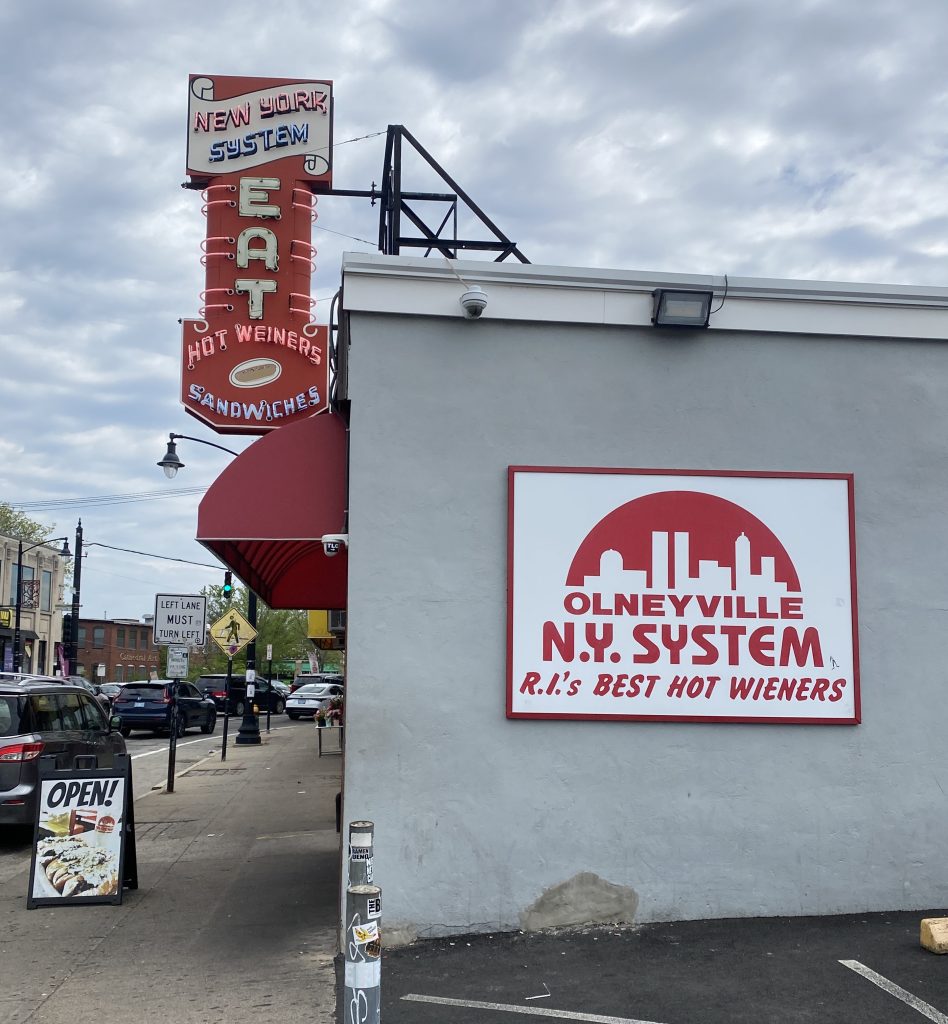
A local institution in Olneyville
Getting oriented
Streets, blocks, and sub-areas
Olneyville Square
The five-way crossroads at the heart of the neighborhood, with shops, services, and a hot wiener restaurant that has been a local institution for generations.
Manton Avenue and the mills
Large brick complexes such as the Atlantic Mills, now home to artist studios, small businesses, and workspaces, with homes on the side streets.
Valley Street and the river
The mill corridor along the Woonasquatucket, with the Rising Sun Mills complex, Donigian Park, and direct access to the greenway.
Toward Atwells Avenue
Mostly residential blocks of two- and three-family homes on the neighborhood’s northern side, closer to the Valley and Federal Hill.
Housing
Homes and architecture
Olneyville’s housing grew up to serve its mills. Most homes are two- and three-family houses built for workers in the late 1800s and early 1900s, with a smaller share of single-families. Owner-occupancy has historically been low compared with the city as a whole, so most homes are rentals, which supports owner-occupant multifamily plans. Converted mills add lofts and apartments, and newer construction has filled some vacant lots.
Two- and three-families: the most common home type and the classic way to own here while collecting rent
Mill lofts: apartments and live-work spaces in converted 19th century complexes
Single-families: fewer of them, scattered on the residential side streets
New construction: infill homes and apartment buildings on formerly vacant land
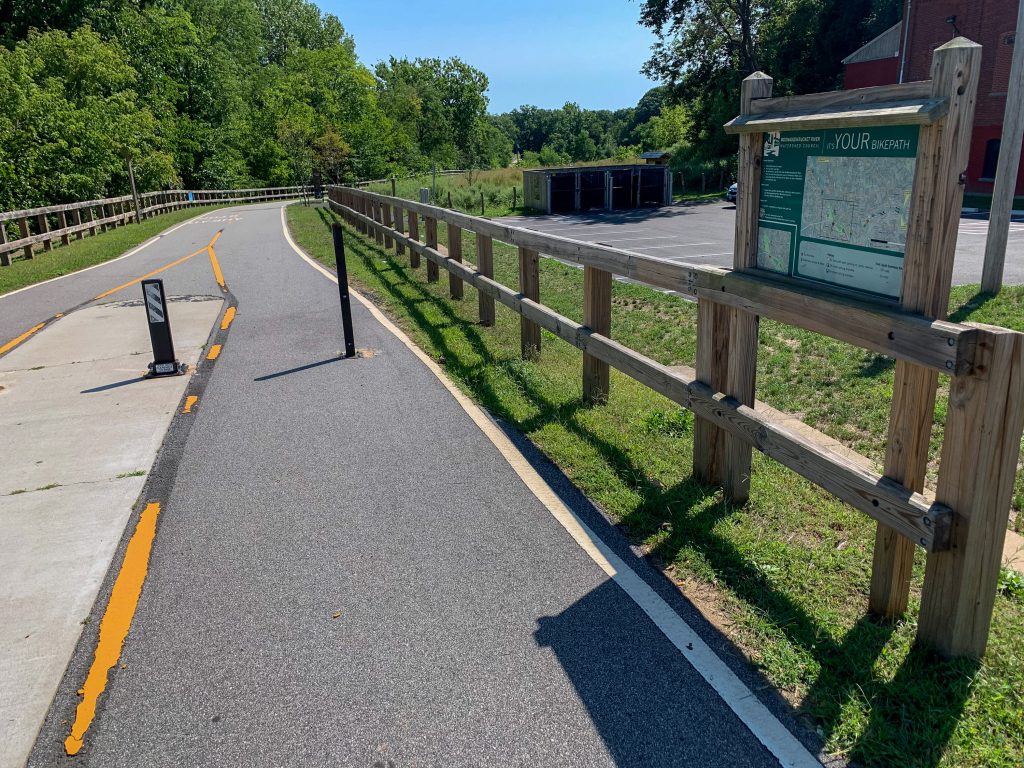
Woonasquatucket River Greenway
Market deep dive
The market and the house-hack math
Olneyville sees only a few sales each month, so the median can swing with the type of homes that happen to close. In September 2026 the median sale price was around $638,000, and homes typically sold in about 51 days. Compare recent nearby sales of the same home type closely before making an offer.
Property taxes, worked out
Providence taxes an owner-occupied 2 to 5 family at about half the rate of the same building owned as an investment.
Home type and value
Rate per $1,000
Yearly tax
Monthly
Owner-occupied 2 to 5 family, $638,000
$7.55
$4,817
~$401
Same 2 to 5 family, not owner-occupied
$14.00
$8,932
~$744
Owner-occupied single-family, $400,000
$8.40
$3,360
~$280
Assessed values often differ from sale prices, and exemptions can change the bill. Rates: City of Providence FY2027 Municipal Levy Ordinance.
For an owner-occupant, the tax savings plus rent from the other units can offset a large part of the monthly payment. FHA and other owner-occupant loans can make a 2 to 4 unit purchase possible with a lower down payment.
Commute & transit
Getting around
On foot: Olneyville Square, the mills, and the greenway are walkable from most blocks
By bike: the Woonasquatucket River Greenway runs about 5 miles from Johnston to Providence Place, where it meets the downtown Riverwalk
By bus: RIPTA routes pass through Olneyville Square on the way to Kennedy Plaza downtown
By train: Providence Station, with Amtrak and MBTA commuter rail to Boston, is about 10 minutes away by car
By car: Routes 6 and 10 border the neighborhood, with I-95 a few minutes east
By air: Rhode Island T. F. Green International Airport is about 15 to 20 minutes south by car
Outdoors
Parks and the river
Riverside Park: on Aleppo Street, with a large playground, fields, and a small boat launch on the river
Donigian Park: on Valley Street, where an off-road stretch of the greenway begins
Joslin Park and Recreation Area: a neighborhood recreation area on Florence Street
Woonasquatucket River Greenway: the path that ties these parks together and continues to Merino Park and Johnston
Community gardens: several neighborhood and school gardens are tended by residents
Lifestyle
Daily life in Olneyville
Olneyville has a working, creative character. The square handles everyday errands, the mills hold studios and small businesses, and the greenway serves as the neighborhood’s backyard for walks and rides. The arts scene runs deep: the Wilbury Theatre Group moved here in 2017, the Manton Avenue Project has run youth playwriting programs here since 2004, and galleries and music venues fill former industrial spaces.
Community groups, including the Olneyville Neighborhood Association, are active on development, housing, and tax questions, so it pays to follow local news about planned projects.
For schools, Providence Public Schools uses a citywide enrollment process; families can review options and school data through the Providence Public School District and the Rhode Island Department of Education.
Honest take
Pros and tradeoffs
What people love
Greenway, parks, and the river close by
Mill history and a strong arts community
Multifamily homes with steady rental demand
Quick access to Routes 6 and 10 and downtown
What to weigh
Few sales make prices hard to read
Highways border the neighborhood on two sides
Older homes can carry higher maintenance costs
Ongoing development is changing some blocks quickly
Buyer checklist
What to check before you buy in Olneyville
Flood zone: look up any property near the Woonasquatucket on FEMA’s flood maps and get an insurance quote early
Older homes: budget for inspections that look closely at lead paint, wiring, heating, and foundations
Multifamily numbers: review leases, rents, and unit condition before you count on rental income
Nearby development: ask about planned projects on nearby mill sites and vacant lots
Comparable sales: with few monthly sales, compare prices against the same home type on nearby streets
Programs: first-time buyers may qualify for RIHousing loans and down payment assistance
FAQ
Questions buyers ask about Olneyville
Is Olneyville good for house hacking?
It can be. Most homes are two- and three-families, most units are rentals, and owner-occupants pay $7.55 per $1,000 instead of $14.00. Run the numbers on rents, taxes, and repairs before you commit.
Is Olneyville in a flood zone?
Some properties near the Woonasquatucket River are. Check each address on FEMA’s flood maps and get an insurance quote before making an offer.
Can you bike from Olneyville to downtown?
Yes. The Woonasquatucket River Greenway runs through the neighborhood and connects to Providence Place and the downtown Riverwalk.
What does a home in Olneyville cost?
In September 2026 the median sale price was around $638,000, but monthly samples are small, and prices vary widely between single-families, multifamilies, and lofts.
Work with Junia
Thinking about Olneyville?
Junia Janvier is a REALTOR® with Corcoran Chart House Realty who helps buyers and sellers across Rhode Island, in English and Haitian Creole. Bring your budget, your timeline, and your questions, and she will help you see where Olneyville fits.
Sources: Redfin neighborhood data, September 2026 (small monthly samples, so expect swings); City of Providence FY2027 Municipal Levy Ordinance; Rhode Island Department of Transportation (Woonasquatucket River Greenway); Rhode Tour; Wikipedia articles on Olneyville, the Atlantic Mills, and the National and Providence Worsted Mills. Figures change often and are provided for general information only; contact Junia for current numbers. Photos: Atlantic Mills by Kenneth C. Zirkel (CC BY 4.0); Olneyville New York System by CastIronSeasoner (CC BY 4.0); river greenway by Kenneth C. Zirkel (CC BY-SA 4.0), via Wikimedia Commons.
Junia Janvier, REALTOR® | Corcoran Chart House Realty | 47 Maple Avenue, Barrington, RI 02806 | (401) 246-4198 | RI License RES.0201111. Corcoran and the Corcoran logos are trademarks of Corcoran Group LLC. The Corcoran® System is comprised of company owned offices which are owned by a subsidiary of Anywhere Real Estate Inc. and franchised offices which are independently owned and operated. The Corcoran System fully supports the principles of the Fair Housing Act and the Equal Opportunity Act.
Equal Housing Opportunity
Top
Stay in the Loop
Get insights, resources & ideas delivered straight to your inbox. No spam, ever.

 Equal Housing Opportunity