The capital city’s historic core: river walks, condo living, and the train at your door.
By Junia Janvier, REALTOR® · Corcoran Chart House Realty · Updated October 2026
Downtown Providence is the city’s business, government, and cultural center, and a growing place to live. This guide covers how downtown grew, its sub-areas and buildings, what condos cost to buy and carry, how residents get around without a car, and what buyers should check before making an offer. Use it alongside a conversation with Junia to decide whether downtown living fits your plans.
Downtown Providence is bounded by Canal Street and the Providence River to the east, Smith Street to the north, I-95 to the west, and Henderson Street to the south. The area was first known as Weybosset Neck, or Weybosset Side, and was settled in 1746 by members of the First Congregational Society near today’s Westminster Street. It grew quickly in the early 1800s as Providence overtook Newport as the state’s commercial center.
Merchants built the mercantile blocks that still line Westminster and Weybosset Streets. The Westminster Arcade, built in 1828, is considered the first enclosed shopping mall in the United States and is now a National Historic Landmark. Late in the 19th century, railroad expansion paved over the Great Salt Cove and two river branches, and a wall of tracks cut downtown off from the State House.
The mid-20th century was hard on the center of the city. I-95 and I-195 construction began in 1956, demolishing hundreds of homes and businesses and separating downtown from Federal Hill, the West End, Smith Hill, and South Providence. Westminster Street became a pedestrian mall in 1964 and reopened to cars in 1989 after the mall era drew shoppers to the suburbs.
Then came one of the best-known urban comebacks in New England. The rail lines were moved and a new train station opened in 1986, the rivers were uncovered and relocated, and Waterplace Park and the Riverwalk were completed in 1994. Capital Center, Providence Place, and new towers followed, and the relocation of I-195 opened land for the Innovation District and the Michael S. Van Leesten Memorial Bridge. Most of downtown is listed on the National Register as the Downtown Providence Historic District.
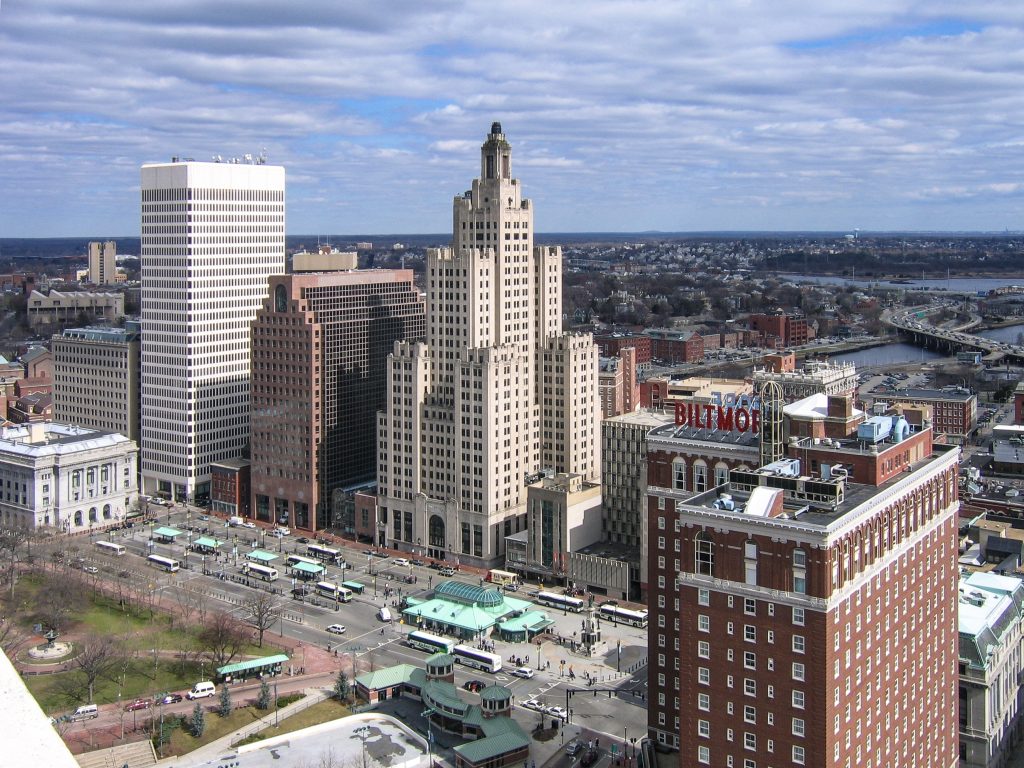
Kennedy Plaza and the skyline
Getting oriented
Streets, blocks, and sub-areas
Downtown is compact, but each part has a different feel. Knowing the sub-areas helps you narrow a search to the right building.
Downcity
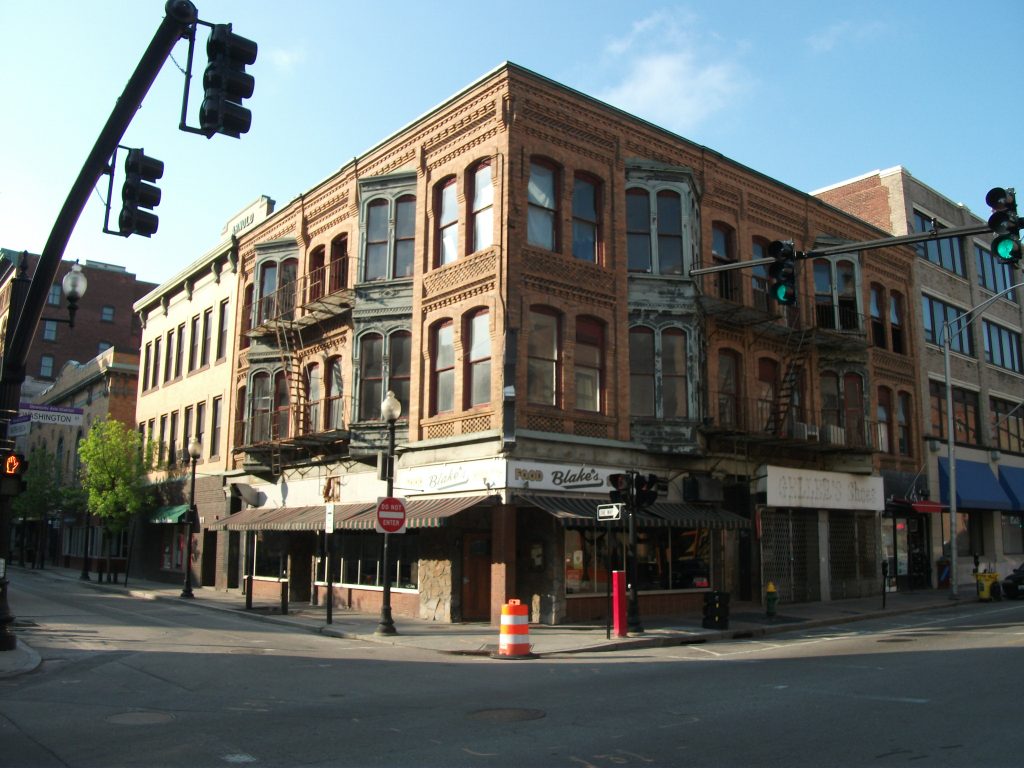
The historic core along Westminster, Weybosset, Washington, and Mathewson Streets, with converted mercantile buildings, lofts, and the Downcity Arts District. Street-level shops and restaurants are steps from home.
Kennedy Plaza and the financial district
City Hall, Burnside Park, and the tallest towers on the skyline, including the Art Deco Industrial National Bank Building. The bus hub is here, so this is the most connected part of the state.
Capital Center and Waterplace
The post-1980s district between the State House and the rivers, with newer condo towers, Waterplace Park, Providence Place, and a short walk to Providence Station.
Toward the I-195 land
The southern and riverfront edge near the Van Leesten bridge, the Jewelry District, and the Innovation District, where much of the newest construction is happening.
Housing
Homes and architecture
Downtown is a condo and apartment market. Historic buildings from the 1800s and early 1900s, in Federal, Victorian, and early 20th century commercial styles, sit beside modernist and postmodern towers. Roughly 88% of housing units are renter-occupied (2020 Census), which means owners who need to move later have a deep rental market behind them.
Loft conversions: former mercantile and office buildings turned into condos and apartments, often with high ceilings and large windows
Condo towers: buildings from the 2000s near Waterplace Park and Capital Center, with amenities, river views, and garage parking in some buildings
Micro-lofts and small units: the Westminster Arcade reopened in 2013 with small residential lofts above its shops
New apartments: a growing number of rental buildings on and near the former I-195 land
Washington Street
Market deep dive
The market and what a condo costs to carry
Downtown has a small number of sales each month, so the median can move a lot with just a few closings. In June 2026 the median sale price was around $659,000, and homes typically sold in about 35 days. Condo association fees vary widely from building to building, so compare the full monthly cost, not just the price.
Property taxes, worked out
Providence taxes owner-occupied homes at a much lower rate than investment properties. Here is what that looks like at downtown price points.
Home type and value
Rate per $1,000
Yearly tax
Monthly
Owner-occupied condo, $500,000
$8.40
$4,200
~$350
Owner-occupied condo, $659,000
$8.40
$5,536
~$461
Same $659,000 condo, not owner-occupied
$14.60
$9,621
~$802
Assessed values often differ from sale prices, and exemptions can change the bill. Rates: City of Providence FY2027 Municipal Levy Ordinance.
Add the association fee and any parking lease to the tax and mortgage to get the true monthly number. If you might rent the unit later, check the building’s rental rules and plan for the higher non-owner-occupied rate.
Commute & transit
Getting around
On foot: offices, restaurants, theaters, the Riverwalk, Providence Place, and the State House are all within a short walk
By bus: Kennedy Plaza is RIPTA’s central transfer hub, with routes to nearly every part of the state
By train: Providence Station is walkable from most of downtown, with Amtrak and MBTA commuter rail to Boston
By bike: the Woonasquatucket River Greenway starts near Providence Place, and the Van Leesten bridge links to Fox Point and the East Bay Bike Path
By car: I-95 and I-195 meet at the edge of downtown; parking is mostly in garages, lots, and metered spaces
By air: Rhode Island T. F. Green International Airport is about 15 to 20 minutes south by car or a short train ride
Outdoors
Parks and the rivers
Waterplace Park and the Riverwalk: cobblestone paths about three quarters of a mile long, set below street level with Venice-style footbridges
Burnside Park: the green beside Kennedy Plaza with an equestrian statue of Ambrose Burnside and a seasonal ice rink next door
The Van Leesten bridge and riverfront park: a car-free crossing of the Providence River on the former I-195 land
Station Park: a small green next to Providence Station
Market Square and Veterans Memorial Park: riverside spaces along the edge of College Hill
Lifestyle
Daily life and the event calendar
Downtown living means errands, dinner, and a show without a car. Johnson & Wales University has its largest campus here, and RISD, URI’s Feinstein Providence campus, and Roger Williams University all have downtown facilities, which keeps streets busy during the school year. AS220, the community arts center on Empire Street, adds galleries, performances, and studios.
Late spring to fall: WaterFire lights bonfires on the rivers on select nights, with music and crowds along the Riverwalk
Year-round: touring Broadway shows at the Providence Performing Arts Center and plays at Trinity Repertory Company
Fall to spring: Providence Bruins hockey and Providence College men’s basketball at the Amica Mutual Pavilion
Winter: outdoor skating at the rink beside Kennedy Plaza
For schools, Providence Public Schools uses a citywide enrollment process; families can review options and school data through the Providence Public School District and the Rhode Island Department of Education.
Honest take
Pros and tradeoffs
What people love
Walk to work, dinner, shows, and the train
Low-maintenance condo living
Historic architecture and river views
Deep rental market if plans change
What to weigh
Association fees can add a lot to the monthly cost
Parking is limited and often costs extra
Event nights and nightlife bring crowds and noise
Few sales each month make pricing harder to read
Buyer checklist
What to check before you buy in Downtown
Association documents: review the budget, reserves, recent minutes, and any special assessments before you commit
Rental rules: confirm whether the building allows rentals, and any limits on short-term or first-year leasing
Financing approval: ask whether the condo is approved for FHA, VA, or the loan type you plan to use
Parking: find out whether a space is deeded, leased in a garage, or not available at all
Noise: visit at night and on an event weekend, and check how close the unit is to nightlife and the highway
Programs: first-time buyers may qualify for RIHousing loans and down payment assistance
FAQ
Questions buyers ask about Downtown
What kinds of homes are in downtown Providence?
Mostly condos and apartments: loft conversions in historic commercial buildings, condo towers near Waterplace Park and Capital Center, and newer rental buildings on the former I-195 land.
Can you live downtown without a car?
Many residents do. Kennedy Plaza is the state’s bus hub, Providence Station is walkable for Amtrak and MBTA trains to Boston, and daily errands are close by.
What does a downtown condo cost to carry?
In June 2026 the median sale price was around $659,000. An owner-occupant at that value would pay about $5,536 a year in property tax at the $8.40 rate, plus the association fee and mortgage.
Is it hard to rent out a downtown condo?
About 88% of downtown homes are rentals, so demand is strong, but each building sets its own rental rules. Check them before you buy, and plan for the higher non-owner-occupied tax rate.
Work with Junia
Thinking about Downtown?
Junia Janvier is a REALTOR® with Corcoran Chart House Realty who helps buyers and sellers across Rhode Island, in English and Haitian Creole. Bring your budget, your timeline, and your questions, and she will help you see where Downtown fits.
Sources: Redfin neighborhood data, June 2026 (small monthly samples, so expect swings); City of Providence FY2027 Municipal Levy Ordinance; 2020 U.S. Census; RIPTA; Wikipedia articles on Downtown Providence, the Westminster Arcade, and Waterplace Park. Figures change often and are provided for general information only; contact Junia for current numbers. Photos: WaterFire by Kenneth C. Zirkel (CC BY-SA 4.0); Kennedy Plaza by Jef Nickerson (CC BY-SA 2.0); Washington Street by Doug Kerr (CC BY-SA 2.0), via Wikimedia Commons.
Junia Janvier, REALTOR® | Corcoran Chart House Realty | 47 Maple Avenue, Barrington, RI 02806 | (401) 246-4198 | RI License RES.0201111. Corcoran and the Corcoran logos are trademarks of Corcoran Group LLC. The Corcoran® System is comprised of company owned offices which are owned by a subsidiary of Anywhere Real Estate Inc. and franchised offices which are independently owned and operated. The Corcoran System fully supports the principles of the Fair Housing Act and the Equal Opportunity Act.
Equal Housing Opportunity
Top
Stay in the Loop
Get insights, resources & ideas delivered straight to your inbox. No spam, ever.

 Equal Housing Opportunity